
The Picts have recently been invading the blogosphere. I didn’t start it, though my rant about the Pictish Arts Society has been part of it. But at about the same time Carla Nayland opened the very vexed question of Pictish matriliny at her blog, and the comments have ballooned into a very interesting exploration of just who and what the Picts were, which is something of course which we will never really be able to settle, but that’s not going to stop bloggers trying :-)
I’ve weighed in quite a lot there already, and when I found myself building another mini-essay for her comment box, I decided at the last minute to bring it here instead. Partly because I’ve dominated that too much already, partly because I think it will work better with pictures that I can’t provide there, and mostly because I want to establish a claim on some of these ideas, which I’ve been wanting to find time to write up properly for ages, in my own space on the web. Selfish, but that’s blogging for you, it’s about thinking you have something to say, isn’t it. So here goes. Let’s mark that with the traditional Pictish Beast and get down to the politics.

Carla says, you see: “There’s little doubt that the people fighting the Romans were the same people who later became called the Picts.” And this is indeed a staple of the field, but I’d have to quarrel I’m afraid. I think Picts means too many peoples. Let me explain.

There’s a huge area of what is now Scotland that Pictland is supposed to cover, in which we can dimly detect lesser political formations. At first there’s the Caledonii and Verturiones mentioned in Ammianus (if that is Ammianus, I forget), then we get a whiff of a kingdom of Argyll later on, this mysterious place Fortriu, Orkney seems to be sort of a kingdom or sub-kingdom apart…
All this could make a model like England, where there are lots of kingdoms and maybe sometimes an overking but we can still talk about the English as a lump, even if maybe not before the Viking Age. But there’s also the material culture. In the North-East, the `Picts’ build (or had built and now lived among) brochs. 
In the south-west they like souterrains to store their grain in, in a way that the rest of `Pictland’ does not. 
In the East and South-East they bury like the British, in long cists, except that sometimes the `Picts’ recycle symbol stones as grave-slabs, which is extremely difficult to understand given what I think the symbol stones are; 
but elsewhere they either like reusing cairns, for important people presumably, or we just don’t really know what they did. Some Pictish place-names are identifiably Pictish because they are recognisably P-Celtic; but some don’t appear to be Celtic at all, and the actual script of the symbol stones, where it’s used, is Ogam imported from Ireland, and has `maqq’ instead of `mapp’ so that the language of writing may even have been Gaelic. 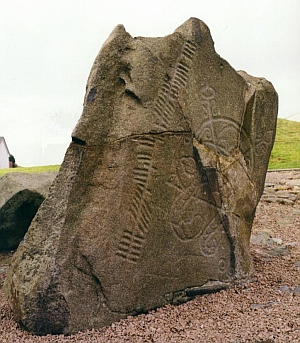
No way are these all the same `people’.
You just can’t talk about Pictish material culture or society the way you can talk about `Saxon’ archaeology, except where we’re dealing with art and the stones, which seem to be élite statements of some kind because they must have cost real wealth to get made. Pictland is a political construct, just like England, which is built out of smaller units; but the lost history of those units seems to be much more various than in England, and we probably need to think of Pictland in terms of something that exists as a unit only for brief periods, like Wales for example except more often than that, and at other times is a grouping for whose various inhabitants and their local cultures only outsiders from beyond the walls would use the same name.
This helps explain another question asked in Carla’s comments, about what happens to the Picts, in fact, because I think that the answer is that really, the most identifable thing about them, their stonework and sculpture, is an élite cultural manifestation that needs to be thought of as court or noble culture. Most of the so-called `Picts’ would have had precious little to do with this stuff, however distinctive it be. So when the élite changes, as it does with Cinaed mac Alpin’s takeover, even if maybe not by much, there is a sea-change in élite self-representation, the nobles may be the same people but they fairly quickly change their fashions, and the result is that we stop seeing the only thing that really identifies itself as `Pictish’ so quickly that we wonder where all the `Picts’ went. Well, they were probably still there but with nothing to identify them by. I bet that Pictish went on being spoken just as much—but then the Vikings arrived and messed up the place-name map for ever.


 A Corner of Tenth-Century Europe
Pingback: The Four Stone Hearth #37 - The Pulp SciFi Edition « Hot Cup of Joe
Hi Jonathan,
I enjoyed reading this post. It helped me understand more about the Picts… I am doing a research paper on Ireland, and am writing the history of ancient Ireland currently and your site came up when I was searching Pictland, from where St. Patrick originated (in Dumbarton). Thanks for the insight.
Phylicia Duran
Glad to have helped, but, er, I should read a little more widely about Patrick than that if I were you. The location of his birth is not securely identified, and Dumbarton was never in Pictland anyway, being the capital of the Britons of Strathclyde! These links may help you.
i dont agree or disagree with your views but what proof is there that the picts were not on the west coast before the britons
The West coast of where, Scotland? or what is now northern England? In the former case I’d say that was a reasonable argument to make: Bede tells us that Nynia’s mission at Whithorn was to the ‘Southern Picts’ and Adomnán has St Columba visit a ‘Pictish’ nobleman on Skye, Artbranan. Added to that there’s a Pictish symbol stone from Gairloch, high up in the North-West near Ullapool, so you could say the west coast is dotted with Pictish indicators, even if nothing like as thickly as the east. That does of course require us to have a meaningful definition of ‘Pictish’ though! The point of this post was that ‘Picts’ and indeed ‘Britons’ are not the same thing everywhere we meet the word, but outside categories for possibly quite disparate groups. A fish symbol doesn’t equate to ethnicity and even less to biological descent.
“The point of this post was that ‘Picts’ and indeed ‘Britons’ are not the same thing everywhere we meet the word, but outside categories for possibly quite disparate groups.”
The point is well made, Jon, and your views are probably shared more widely now than when you wrote the post 3 years ago. Old ideas about dividing early medieval North Britain into big, neat ethnic chunks simply don’t stand up any more. The archaeology (as you nicely demonstrate with images) suggests a much more fragmented Pictland, as does the textual evidence when we look at it more closely.
As to the question of ‘Picts’ in Strathclyde, I’m still trying to weigh St Patrick’s apparent distinction between Picts and Dumbarton Britons against the possibility that the Romans called everyone north of Hadrian’s Wall a ‘Pict’. This makes me wonder which ‘Picts’ Patrick was talking about, and whether he threw this label around quite casually without pausing to think what ‘Pictishness’ really meant in his own time.
He seems at least to have been fairly directed with his use of the term ‘Roman’, but to follow the argument of Guy and others there’s a very real possibility that ‘Pict’ for him was just “no-one with whom I care to identify, north of the Wall’, I agree…
I hope to work this argument up as a real paper in the coming year, so I hope not too many more people agree just yet. At least I have prior art!
Hi Phylicia,
Sad to say, we have no idea where exactly in Britain Patrick came from. He names his home area, but it has never been located, so any sources listing it as in Pictland, Dumbarton, or anywhere else is spurious. Please, get a solid book on Irish history – I recommend the paperback version of “A New History of Ireland” (volume one), which covers the eras up to 1169. It annoys the bejasus out of me that so many get so much of our history sooo wrong. If that one seems a bit much for you (and I guess it is fairly academic!), please try Dáibhí Ó Cróinín’s “Early Medieval Ireland, 400-1200”. Oh and remember that Patrick wasn’t the first Bishop of the Irish, he was preceeded by Palladius in 431. Best of luck on your research paper – may I ask what is the exact subject?
Is mise,
Adrian Martyn.
These are solid recommendations, but if Phylicia is still writing that research paper five years on I suspect she needs more help than a blog can give her…
Hm, guess my information was severely off! Thanks for the links…
very interesting and I think you are right on the money with how they Picts “disappeared” through some sort of assimiliation. It happens worldwide….like the Anastazi for instance.
This really was interesting. I thought we might have the oldest US archeology in the Ohio Valley with the Adean peoples and the Anasazi out west but the Picts appear to be older. Its really breathtaking that you have structures, stones and language to explore from this time period. I became interested in Picts reading that the Romans found them frightening in battle because of the blue tatoo art work on their naked bodies. So much to explore there. Their choice of tatoo imagery, their war style mind set and why did it frighten Romans. It would take alot to frighten Roman soldiers I’d think! That would be some art work to see! Oh to be a fly on a tree watching the Picts interacting, or better yet, tatooing one another other. Betty, Texas.
There’s considerable argument, among the very small group of people who care about such things, about whether they really did have tattoos or whether they just wore body-paint for battle; the most recent thing on the subject is Kyle Gray, “Tattoo Redux: Picti, Pechts and the Motherland” in Journal of the Pictish Arts Society Vol. 12 (Edinburgh 1998), pp. 24-39, but it gets a bit crazy about the importance of mothers in Pictish society. It does collect all the references to painting and/or tattooing though; there aren’t so very many… Glad you found the post of interest!
Please forgive my uneducated comments and thank you so much for replying and for your journal reference that perhaps I might be able to locate on the internet. The artistic talents, skills, tools and artistic spiritual perspectives of world cultures, historically is so interesting to me, with art being a common thread for man throughout human history. I want to credit the Picts with being a particularly artistic people. I realize much is just not known. Thank you again.
They definitely had their own unique style, though as I say in this post, who “they” are in this instance is a difficult question and I think the art may have been almost all that united them, at least as far as we can now see. I don’t think you’ll find the PASJ online, not least because the Society that originated it is now rather troubled, but you may get somewhere with what’s left of their old website or the Yahoo group they briefly had running. The new site is up but not finished, and the contact details on that might be good; if so, I’m sure they’d at least be able to e-mail you scans of the article. If not, comment back here and I’ll see what I can do with my copy.
All links above were good, and appreciated. Most sites show the stone art and symbols.
I’m thinking there probably isn’t anything showing a painted Pict warrior? The pre-Book of Kells Pict history and their possible influence on the monk artists of Iona is very interesting. I wish Scotland much success in discovering more artifacts and information on their Pict history. A very interesting history for sure. Betty.
I’m afraid I don’t know of anything actually showing the warriors painted, no, and this might be one field where I can be reasonably confident that I would. Who knows if the stones used to be painted, of course! It has been suggested that they were, at least.
Jonathan, I found a North Carolina University web site which seems to give engraved illustrations of Pict warriors, found in the book, “A True Report of the New Found Land of Virginia” written in 1588 by Thomas Hariot. Hariot includes engravings by Theodor de Bry of Picts to explain what other countries primative warriors looked like (I guess in comparrison to American primative indians).
The website is:
learnnc.org/lp/multimedia/6277
I am also going to try and forward the page to you. I would just search learnnc.org and then search Pict engravings.
I would be interested to know what you thought after viewing this. -If interested. Betty.
Well, I think that de Bry knew no more than we do and probably less, given that as an ex-pat Fleming I doubt he knew the symbol stones well! What we have here is an illustration of the tradition of the Picts of Tacitus’s Agricola isn’t it, and not anything with evidential value for the Picts themselves.
I agree. Still there it is for all to see whether or not they may or may not be a discerning viewer. Just for your information the original John White paintings (from which the engravings came from)are surprisingly enough on this web site: posters.com just search John White, artist. ~Thank you for your input. I really appreciate it. I think until any real evidence turns up, my recreational search is done. Betty.
The pict’s didn’t disappear, they just mixed in with the population.
As indeed I say: “Well, they were probably still there but with nothing to identify them by.” Thanks for reading.
I think maybe acient picts is some old remain of bask or finno-ugri tribes in scotland,because they wery old and so different from celtic.Its known that befoure indo-european tribes arrived to europa,in west side europa live mostly bask tribes and in east side mostly finno – ugri tribes.
There are certainly elements of placenames in Pictland that have no Celtic root, but neither do they appear to relate to Basque or Finno-Ugric I’m afraid. Graham Isaac’s “Scotland” in New Approaches to Celtic Place-Names in Ptolemy’s Geography, edd. J. de Hoz, E. R. Luján & Patrick Sims-Williams (Madrid 2005), pp. 189-214, is probably the best thing to read on this now. Hope that helps.
Pingback: ‘Iron Age’ Picts and their spoken language « A Corner of Tenth-Century Europe
Hi Jonathan I stumbled across this site while sitting remincing on my days at Dundee University where part of my honours degree during the eary nineties was The Historical Geography Of Scotland under the tutorage of Alan Small,now sadly deceased.One of the aspects of this course looked into the Picts and what trace of them was left on the landscape,two aspects of this still puzzle me to this day,the uniqueness of Brochs as an almost wholly Pictish phenonomum and the siting of and distribution of Pictish symbol stones and their relationship whith each other and to their surrounding environment.I can still remember a piece of work I handed in where I came to the conclusion that these Brochs were mainly status symbols and not primarily defensive stuctures.As they are all generly built within a very short distance of the sea,I had toyed with the idea that they may have been used agianst sea bourne invaders or Pirates but who with exception of the Romans would have had such maritime technology?
Hullo Graham! It’s worth remembering that the Picts themselves had a bit of a name as sea-raiders, as did the Saxons, so by the late-Roman period there was certainly some reason to have such forts as the Saxon Shore arrangements show. And one of the points of this post is to stress that Picts did not necessarily act as a unit within Pictland so Picts arming against Picts shouldn’t be ruled out. The problem is that, unless I am badly out of touch with the scholarship, the brochs and wheelhouses are earlier than that, second to first century B. C., so don’t seem to address the post-Roman strategic issues but some earlier ones, and furthermore can’t easily be called Pictish either. The thing that puzzles me about this is that the kingdom of Orkney which we can assume to have occupied part of that zone didn’t re-use or build over this stuff but just kept it going. The cult of ancestors must have been pretty serious there…
Pingback: Leeds 2010 Report III « A Corner of Tenth-Century Europe
A gathering of wannabe Picts,LOL!
Pingback: The Wester Ross antiquarian « A Corner of Tenth-Century Europe
Pingback: Picts in many places, if ‘Picts’ is the word « A Corner of Tenth-Century Europe
Pingback: Picts in many places… « Senchus
Pingback: Leeds 2011 report two at last « A Corner of Tenth-Century Europe
Pingback: Seminar CVIII: framing early medieval Scotland « A Corner of Tenth-Century Europe
Pingback: Bringing Scotland to Oxford: the O’Donnell Lectures for 2013 | A Corner of Tenth-Century Europe
Pingback: Pictish Pandemic Roadtrip, Part I | A Corner of Tenth-Century Europe